
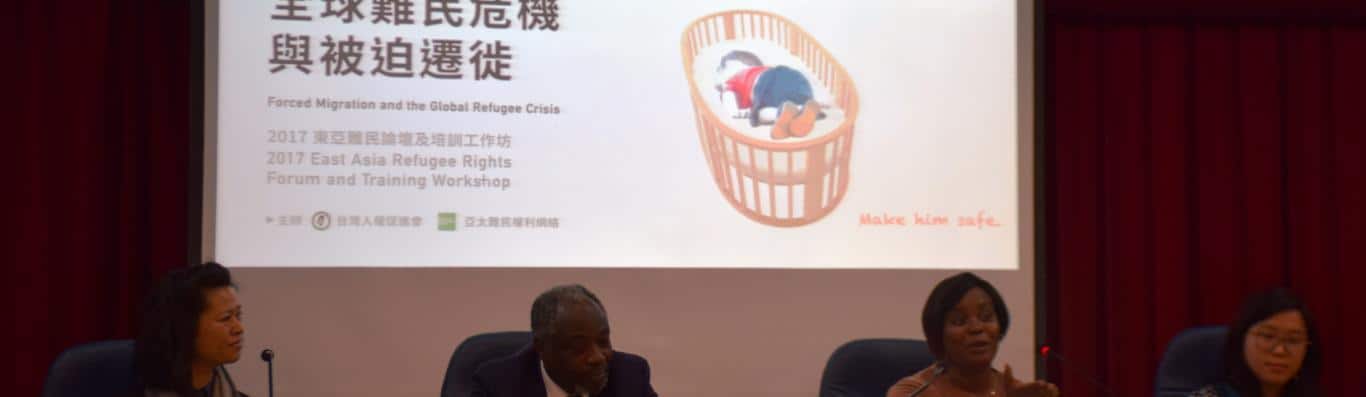

▋A war ended more than 50 years ago. Why are some people still unable to return home today?▋And when they come to Taiwan seeking asylum, what challenges await them? In 1967, Biafra declared independence from Nigeria, and a war that would last nearly three years broke out. The war eventually came to an end, and the short-lived Republic of Biafra ceased to exist. But for many Biafrans, the suffering did not end there. Ethnic divisions rooted in colonial rule, the collective trauma of war, ongoing political persecution, and displacement continue to envelope Biafran communities scattered around the world today. But…
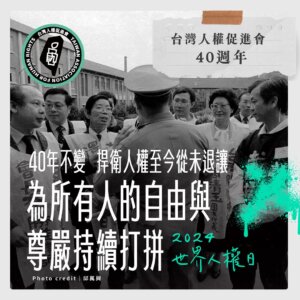
Forty years ago, freedom and democracy were still farfetched dreams in Taiwan. Our predecessors, risking their liberty and even their lives, laid the foundation for human rights and democracy. Today, we carry on their beliefs and perseverance, facing new challenges with the firm conviction that human rights are the foundation of nation-building. Over the past forty years, human rights awareness has progress despite of threats from the authoritarian regime. However, we are keenly aware that democracy and human rights may regress at any moment of complacency. A healthy democracy requires unfiltered voices. This year, we have delved into key issues…
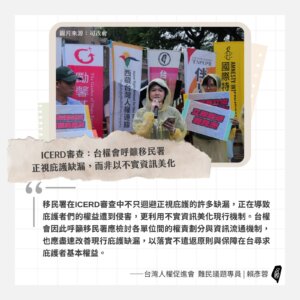
After more than half a century, the International Convention on the Elimination of All Forms of Racial Discrimination (ICERD), which became legally binding for our country in 1971, finally held its first national report review meeting from April 22 to April 23. This meeting formally concluded today (April 26) with the review committee issuing its concluding observations. Below is the full text of the speech presented by our association concerning the refugee asylum of this review: During a recent ICERD review meeting, serious concerns were raised about how the Immigration Agency is handling refugee asylum issues. Critics argue that the…
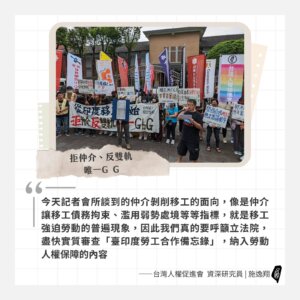
Taiwan-India Memorandum of Understanding on Labor Cooperation, which has sparked significant social controversy, was confirmed to be advanced from its “for reference” status to “review” by the Social Welfare and Environmental Hygiene Committee of the Legislative Yuan on April 4th. And the migrant workers’ rights groups will continue to monitor the progress of the review. The MOU not only lacks transparency in its signing process but also fails to address the shortcomings of past policies concerning migrant workers. Within the brief thirteen articles of the Taiwan-India MOU, aside from mentioning basic principles such as compliance with the law, equal treatment…

Translated by: Zoe Wang, Intern On June 20th, which is World Refugee Day, Taiwan Association for Human Rights and Amnesty International Taiwan held a press conference together with a Congressman and members of different civil groups. They called on the Taiwanese government to publicize progress on creating a refugee law, implement the findings from the Third National Review of ICCPR and ICESCR (兩公約第三次國家報告), write the non-refoulement principle into law, and improve the asylum system. They also called for the establishment of an effective refugee status determination mechanism that protects refugees on the front lines of law enforcement while improving the…
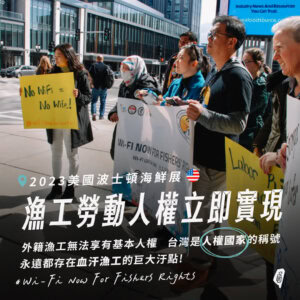
Translated by: Chl, Intern Edited by: Zoe Wang, Intern (Photo: Wi-Fi Now for Fishers’ Rights at Sea) Migrant fishers campaigned for fundamental labor rights and Wi-Fi access while at sea alongside several domestic and international NGO groups. On Monday Taiwan time, they arrived in Boston and held peaceful demonstrations outside the Seafood Expo North America. Shi Yixiang, Secretary-General of the Taiwan Association for Human Rights: “Many say that Taiwan is a free and democratic country that values human rights in the Asia Pacific region, and that it is a technological powerhouse where everyone can easily enjoy convenient and inexpensive…
translate and publish on Sep. 15 Taipei Times Taiwan urgently needs refugee law By Clarence Chou and Chiu Ee-ling Article 18 of the Laws and Regulations Regarding Hong Kong and Macau Affairs (香港澳門關係條例) states: “Necessary assistance shall be provided to Hong Kong or Macau residents whose safety and liberty are immediately threatened for political reasons.” In Taiwan, with the escalating violence and ongoing protests in Hong Kong, Hong Kong democracy activist and Demosisto Secretary-General Joshua Wong (黃之鋒) published an article last week expressing hope that the Taiwanese government would include Hong Kong demonstrators in Article 18. He…
Nine Chinese exiles get residency after years without status By Alison Hsiao / Staff Reporter Nine Chinese exiles in Taiwan — five dissidents and four Falong Gung practitioners — have been granted long-term residency permits after living in the nation for between five and 10 years without official status. They can become Taiwanese citizens after two years. According to the Epoch Times and Radio Free Asia, the nine Chinese exiles had originally asked for political asylum and have been granted long-term residence permits by the government. The Mainland Affairs Council (MAC) confirmed the news yesterday. The five Chinese dissidents…
UDHR the international human rights convention and the international society have confirmed the right to asylum. If a person is prosecuted by his country because he defends his own or other people's human rights, the other countries have an obligation to provide protection and follow the non-refoulement principle. Besides,states should prevent the stateless status and protect the stateless people. Taiwan, is a democratic country proud of its human rights situation in Asia. How does the country treat the asylum seekers and stateless people? It will only take you a few minutes through the 3 short films to understand these people's…
Good evening, Mesdames and Messieurs, Taiwan Association for Human Rights have advocated for exiled Chinese dissents, Tibetans, Thai-Burma boarder stateless people to seek asylum and residence in Taiwan. 9 Chinese dissents and hundreds of Tibetans and Thai-Burma boarder stateless people have stayed in Taiwan for more than 8 years, some of them have naturalized, many only have short term or long term visas and are not permitted to work and cannot enjoy any health insurance, social insurance and social security against ESCR article 6 and 9. When an asylum seeker enters Taiwan illegally, they are likely to stay as an…